
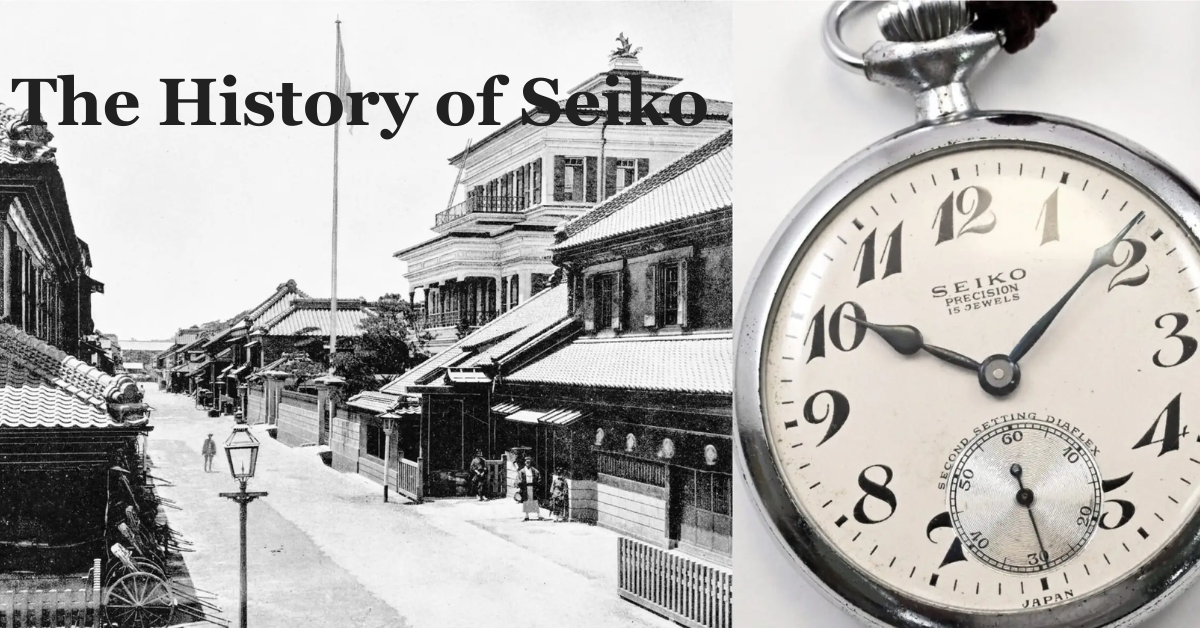
Few horological names bring as much gravity, esteem, and a bit of disruptive panic as Seiko. And for over 140 years now, under the single-minded and relentless philosophy established by its founder, Kintaro Hattori, “Always one step ahead of the rest,” the Japanese giant has existed. While many Swiss brands pride themselves on maintaining centuries-old traditions. Seiko’s history is defined by a willingness to tear up the rulebook. From the world’s first quartz wristwatch that nearly toppled the entire mechanical industry to the invention of the Spring Drive. Movement that many deemed physically impossible. Seiko has redefined what it means to keep time.
The Foundation: A Vision in Ginza
What is today called early success by Seiko had to be traced to 1881, when a 21-year-old named Kintaro Hattori. He opened a small shop in Tokyo’s Ginza area, from where clocks were repaired and sold. By 1892, his own manufacturing began under the name Seikosha (“House of Exquisite Workmanship”).
Seiko didn’t just want to make watches; they wanted to master every single component of them. This obsession with “in-house” production became the DNA of the brand, setting the stage for the massive technological leaps of the 20th century.
1969: The Year the World Changed (The Astron Quartz)
On Christmas Day of 1969, Seiko rolled out a watch that went on to change the course of history: the Seiko Quartz Astron 35SQ.
The Swiss watch industry was at the unbeatable top during this period, using mechanical movements that had hardly changed in decades. Seiko’s Astron was a radical departure. Seiko defined a completely new way of thinking with its Astron. It employed a timekeeping tradition based on a quartz crystal oscillator. It offeres levels of accuracy within five seconds per month, which no mechanical watch could even dream of achieving.
Why the Astron Was Revolutionary:
> Precision: It was 100 times more accurate than any mechanical watch of the period.
> Price of Innovation: The first Astron came in 18k gold and was priced at 450,000 yen-a price not unlike that of a medium-sized automobile at the time.
> The “Quartz Crisis”: While Seiko viewed it as a “Quartz Revolution,” the Swiss viewed it as a crisis. It led to the collapse of many traditional brands, forcing the industry to reinvent itself as a luxury pursuit rather than a purely functional one.
Seiko didn’t keep the technology to themselves; they opened many of their patents to the world. This move democratized accurate timekeeping, making reliable watches affordable for everyone, not just the elite.
The Quest for the “Everlasting” Watch
Following the success of quartz, Seiko faced a new challenge. Quartz watches were accurate but required batteries. The mechanical watches, being booming with vigor, were self-winding but lacked impeccable precision.
This conjured the question in the minds of Seiko engineers: Is there no way to marry the soul of a mechanical watch with the precision of a quartz watch?
This led to several “hybrid” milestones:
1. Seiko Kinetic (1988): Once referred to as AGM, it was the first wristwatch capable of converting kinetic energy from the movement of the wearer into electrical energy to power the quartz movement.
2. Persistence of the Mechanical: While quartz had anchored its supremacy in watchmaking, Seiko never stopped furthering its mechanical calibers, especially in the Grand Seiko line, experimenting with newer alloys and higher beat rates.
The 28-Year Journey to Spring Drive
If the Astron was Seiko’s most disruptive invention, the Spring Drive is arguably its most poetic. The idea was conceived in 1977 by a young Seiko engineer named Yoshikazu Akahane. He dreamt of a “persistent” watch, one that was driven by a mainspring (no battery) but regulated by electronic technology for ultimate accuracy.
It took 28 years, 600 prototypes, and over 230 patents to bring this dream to life. Finally, in 1999 (and released in its most famous form in 2004), the Spring Drive was born.
The Magic of the Spring Drive Movement
The Spring Drive is unique because it replaces the traditional escapement (the “ticking” part of a watch) with a Tri-synchro Regulator.
- Mechanical Power: It uses a traditional mainspring, wound by the movement of the wrist. There are no batteries or capacitors.
- Electronic Regulation: An IC (Integrated Circuit) and a quartz crystal regulate the release of that energy.
- The “Glide Motion”: The fact that no escapement “chops” the energy means that the seconds hand does not tick. Instead, it flows in an absolutely smooth, continuous motion, really as time does flowing freely.
- Accuracy: The extraordinary figures for the accuracy are around +/- 1 second per day for premium watches, and it exceeds significantly these standards by massive dimensions.
Seiko’s Legacy Today: A Dual Identity
Today, Seiko occupies a unique space in the market. On one hand, you have the “Everyman’s Seiko” the Prospex divers and Presage dress watches that offer incredible value. On the other, you have the high-artistry of Grand Seiko and Credor, where the Spring Drive and high-beat mechanical movements compete with the finest Swiss houses.
Key Pillars of Modern Seiko:
- Prospex: Their professional-spec sports watches, famous for the “Tuna” and “Turtle” dive watches.
- Presage: This is a collection that celebrated the Japanese aestheticism, featuring mostly hand-enameled dials or the “Cocktail Time” designs.
- Sustainability: Seiko will always prop up watches with solar technology and durable mechanical movements so as not to find their resting place into landfill.
Final Thought
The history of Seiko is not merely a list of products; it tells the story of Japanese Monozukuri, the passionate spirit with which things were made with care, accuracy, and continuous improvement.
From the Astron-with time made available, and accurate to shake the traditional ideas of the horological world-to the Spring Drive, marrying the “heartbeat” of a mechanical watch with that “brain” of electronic regulation. Next Blog: Top Seiko Watches for Christmas Gifts This Year