
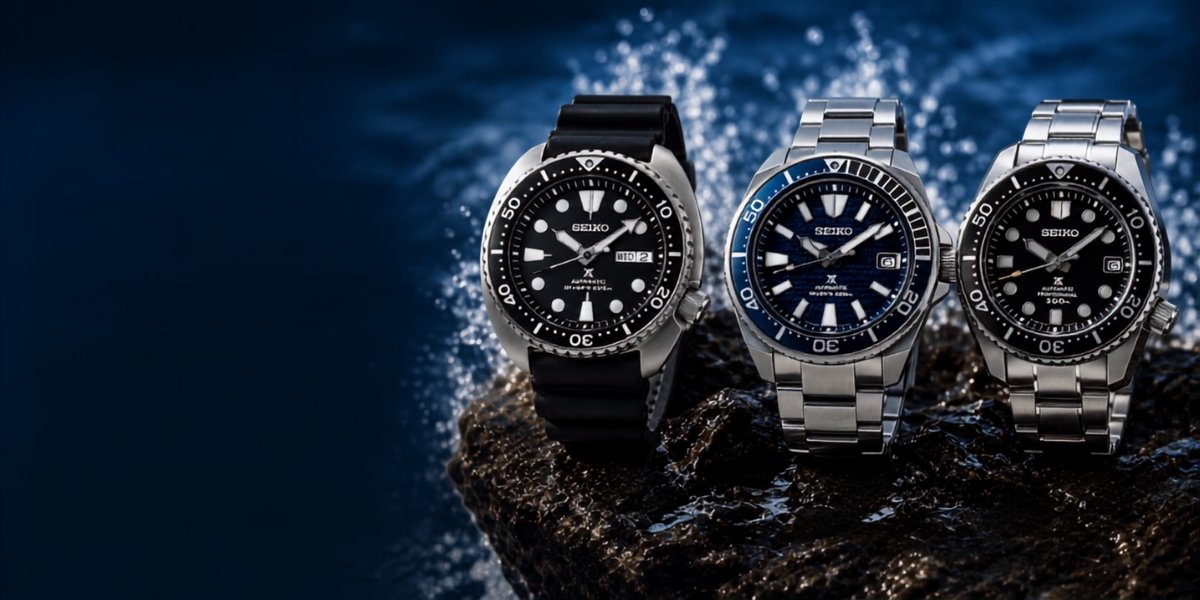
The best Seiko dive watch depends on your budget and how you’ll actually use it. For under $300, the Prospex Solar Diver is the easiest to live with. Around $400–500, the Turtle and Samurai deliver genuine 200m ISO 6425 diving capability with real character. At $650–800, the Sumo steps up in finishing and case quality. And for divers who want Seiko’s most serious tool watch, the Marinemaster (Prospex 300m Heritage line) is the one professionals actually wear.
Why Seiko Owns This Category
Seiko built Japan’s first dive watch in 1965, and it’s been refining the formula since. That’s not marketing copy — it’s just how long the company has had to work out what actually survives saltwater, pressure, and a diver who forgets the watch is even there. The 1968 reference 6159-7001 met ISO 6425 standards before those standards technically existed. Six decades later, that same obsession with over-building shows up in a $500 Prospex just as much as a $4,000 Marinemaster.
That range is the interesting part. Rolex and Omega dominate the conversation at the top of the dive watch market, sure, but Seiko covers more ground underneath it than almost anyone else. You can start at $250 and still get a real, ISO-certified diver — not a beach-party lookalike with a screw-down crown for show.
I’ve pulled together seven models that represent the meaningful choices in that range, compared on the things that actually matter once the watch is on your wrist: movement, water resistance, case comfort, and where each one starts to feel like a compromise.
Quick Comparison Table
| Model | Price (approx.) | Water Resistance | Movement | Best For |
|---|---|---|---|---|
| Prospex Solar Diver (SNE583) | $350–400 | 200m | Solar (V157) | Low-maintenance daily wear |
| Seiko 5 Sports (SRPD-series) | $250–300 | 100m (not ISO diver) | Automatic (4R36) | Budget everyday sports watch |
| Prospex Turtle (SRPE93) | $450–525 | 200m | Automatic (6R35) | Vintage character on a budget |
| Prospex Samurai | $450–550 | 200m | Automatic (4R35/6R35) | Sharper, modern styling |
| Prospex Sumo | $650–800 | 200m | Automatic (6R35) | Elevated finishing, larger wrist |
| Prospex 200m Automatic (SPB) | $700–1,200 | 200m | Automatic (6R35) | Everyday professional-grade diver |
| Marinemaster / Heritage (SLA/HBF) | $2,800–4,600 | 300m | Hi-Beat automatic (8L35) | Serious diving, long-term ownership |
1. Prospex Solar Diver (SNE583) — Best for Low-Maintenance Wear
If you want dive watch capability without thinking about winding, setting, or accuracy drift, the solar line solves that outright. The SNE583 offers water resistance up to 200 meters, a screw-down crown and caseback, and an energy-efficient solar cell that needs no battery replacement — roughly a 10-month power reserve when fully charged. Charge it under any light source, occasionally, and it just runs.
The trade-off is obvious if you’re into mechanical watches: there’s no rotor to admire, no hand-winding ritual. But as a genuine 200m diver you can wear through a decade of beach trips and pool days without a service interval hanging over your head, it’s hard to beat at this price. Solar sits inside the same Prospex collection as every automatic model on this list, if you want to see how it fits alongside the rest of the lineup.
2. Seiko 5 Sports (SRPD-series) — Best Budget Entry Point
Worth including here even though it’s not a certified dive watch. The Seiko 5 Sports line inherited some of the SKX’s design DNA after that model was discontinued, and it’s become the default “affordable automatic with dive-watch looks” recommendation for people just getting into mechanical watches.
Water resistance tops out around 100m, so this isn’t something to actually dive with — treat it as a sporty daily-wear piece that borrows the aesthetic. The 4R36 movement inside is basic but reliable, and at $250–300 it’s genuinely one of the better values in automatic watches, period. Our Seiko 5 Sports guide covers the full model range in more depth. If you want the real diving spec, though, skip ahead to the Turtle.
3. Prospex Turtle (SRPE93) — Best Vintage Character
The Turtle earns its nickname from a case shape that dates back to the 1976 6309-7040, and it wears that heritage well. Inside, you get a proper Prospex spec sheet: a 24-jewel automatic 6R35 movement, screw-down crown and caseback, and genuine 200m water resistance that meets ISO 6425 diving standards.
What sells the Turtle isn’t any single spec — it’s how the whole package feels. The bezel action has real resistance and a satisfying click. The dial is clean and legible without trying too hard. At $450-ish, it undercuts most of the competition while still feeling like a serious tool watch, not a cosplay of one. Our buyer’s guide to the best Seiko watches under $500 and $1,000 covers how the Turtle stacks up against other watches at this price.
4. Prospex Samurai — Best for a Sharper, Modern Look
Same core spec as the Turtle — 200m water resistance, ISO 6425 certification, screw-down crown — wrapped in a case that couldn’t look more different. The Samurai’s angular lugs and faceted bezel give it a much more aggressive, modern silhouette. If the Turtle feels a little too retro for your taste, this is the answer.
It runs slightly smaller lug-to-lug than the Turtle, which helps it sit better on smaller wrists despite the bold styling. Between these two, honestly, it comes down to which case shape you’d rather look at every day — the underlying capability is close enough that spec sheets won’t decide it for you.
5. Prospex Sumo — Best Step-Up in Finishing
The Sumo sits a clear notch above the Turtle and Samurai in case work. Sharper angles, better polish transitions, and a dial that reads as genuinely refined rather than just functional. It’s still built around the 6R35 movement with its dependable 70-hour power reserve, but the execution around it feels a level more deliberate.
One thing to flag honestly: the Sumo wears large. A 52.6mm lug-to-lug measurement means it can overwhelm smaller wrists even though the 45mm case diameter doesn’t sound extreme on paper. Try one on before you commit if you can, or at least measure your wrist against the lug-to-lug spec first.
6. Prospex 200m Automatic Diver (SPB-series) — Best Everyday Professional Diver
This is where Seiko’s Prospex range starts to feel less like an enthusiast watch and more like actual dive equipment. The 200m Automatic Diver comes in black, green, and blue dial variants, all built around the same 6R35 caliber and the same no-compromise water resistance rating. The finishing is a step above the Turtle and Samurai — brushed and polished surfaces that catch light deliberately rather than by accident.
At $700–1,200 depending on the reference, you’re paying for consistency more than any single flashy feature. This is the watch that gets worn every day for years without complaint, which is honestly the highest compliment a tool watch can get. It’s also a regular pick in our best watches under $1,000 roundup, alongside other Prospex references worth cross-shopping.
7. Marinemaster / Prospex Heritage (SLA / HBF) — Best for Serious Diving
The Marinemaster is Seiko’s answer to “what if we didn’t compromise on anything.” Rated to 300m, ISO 6425 certified, and built around the 8L35 Hi-Beat movement running at 28,800 vibrations per hour — twice the frequency of the 6R35 found in the rest of the lineup. That higher beat rate means a smoother sweep of the second hand and noticeably tighter positional accuracy, at the cost of a shorter 50-hour power reserve.
The current HBF001 and HBF002 references trace their design straight back to the 1968 6159-7001, which was doing 300m water resistance before the ISO standard for dive watches formally existed. This is the watch actual working divers reach for when they want a Seiko they can trust without a second thought. It’s also, understandably, the most expensive watch on this list by a wide margin — $2,800 to $4,600 depending on reference and edition. For more on how this lineage fits into Seiko’s broader story, our history of Seiko, from Astron quartz to Spring Drive is worth a read.
How to Pick Between Them
Start with how you’ll actually wear it, not how it looks in a photo. If you want something you never have to think about, go solar. If you’re building a first mechanical collection and want dive watch looks without the full commitment, the Seiko 5 Sports is the easy on-ramp — just know it’s not a real diver.
For anyone who wants genuine ISO 6425 capability without spending four figures, the Turtle and Samurai are the sweet spot, and the choice between them is really about case shape. Step up to the Sumo or the 200m Automatic line once finishing quality starts to matter more than price. And if you’re actually diving — not just wearing a dive watch to the office — the Marinemaster is the one that was built for that job first and everything else second.
Frequently Asked Questions
Are Seiko dive watches actually safe to dive with?
Any model labeled Prospex Diver’s is ISO 6425 certified, meaning it’s tested for water resistance, legibility, shock resistance, and magnetic resistance under professional diving standards. The Seiko 5 Sports line, despite its dive-watch styling, is not ISO certified and shouldn’t be used for actual diving.
What’s the difference between the Turtle and the Samurai?
Both share the same 200m water resistance and 6R35-based movement family, so the real difference is case shape. The Turtle uses rounded, vintage-inspired lugs, while the Samurai has a sharper, faceted, modern profile. Pick based on which one fits your wrist and style, not capability.
Is the Seiko Sumo worth the jump in price over the Turtle?
If finishing quality and a more refined case matter to you, yes. The Sumo offers noticeably sharper case work for roughly $200–300 more, though it also wears larger — check the lug-to-lug measurement against your wrist before buying.
How often do Seiko automatic dive watches need servicing?
Most Seiko automatic movements, including the 6R35 and 8L35, are generally recommended for service every 3 to 5 years, similar to most mechanical watches. Regular wear actually helps keep the movement’s lubricants distributed properly.
Why is the Marinemaster so much more expensive than the rest of the Prospex line?
The price jump reflects the 8L35 Hi-Beat movement, 300m professional-grade water resistance, and significantly higher case finishing standards compared to the 6R35-based models. You’re also paying for a more direct lineage back to Seiko’s original 1968 professional diver.
Can I swim and shower with a 100m-rated Seiko like the Seiko 5 Sports?
Light splashes and handwashing are generally fine, but 100m ratings aren’t intended for swimming or diving despite the number sounding generous. For anything in the water, choose a 200m ISO 6425-certified Prospex model instead.
The Bottom Line
Seiko’s dive watch range doesn’t really have a wrong answer — it has a right answer for your budget and how seriously you take the “dive” part of dive watch. If you’re weighing this against other picks in the Seiko catalog entirely, our Seiko top models overview is a useful next stop. Otherwise, match the watch to how you’ll actually wear it, and any of these seven will outlast the decision you made buying it.